
By WYATTE GRANTHAM-PHILIPS, KELVIN CHAN and KAITLYN HUAMANI AP Business Writers
Inaccessible email inboxes. Banking delays. And a communications meltdown that grounded airplanes for hours, followed by waves of other travel disruptions.
In an increasingly interconnected world, some fear such disruptions could be the new normal.
Over the past week alone, problems that appeared to emerge from routine updates, security patches or other malfunctions surfaced at Microsoft, JPMorgan Chase and Apple, and even the U.S. government’s Federal Aviation Administration and National Security Agency. The Trump administration said there was “zero” indication the latest outages are linked, or caused by bad actors like cybercriminals.
The era of artificial intelligence has also raised the stakes for internet security overall. As AI tools uncover new vulnerabilities, many other companies and institutions are racing to patch them before they can be targeted by hackers, a cat-and-mouse game that can lead to a different set of glitches.
Social media platforms have been abuzz with a mixture of annoyance, confusion, conspiracy theories and jokes about the string of outages.
“To see several disruptions this close together, I think to a lot of people it’s made them realize how many parts of their lives they’ve handed over to these systems that we still, at this point, don’t fully understand,” Jake Smith, a content creator who regularly posts videos about politics on platforms like Instagram and YouTube, said in an interview. “I think it gives people a sense of helplessness to see all of it happening concurrently in a way.”
What’s gone offline recently
Outages and technology errors have piled up across sectors.
Late last week, a global Microsoft outage disrupted email and other workplace tools, plunging business and everyday services into disarray worldwide. Microsoft 365 services, including Outlook, Teams and AI assistant Copilot, were interrupted. Microsoft cited, in part, a failure during a recent upgrade to its servers, spanning from what the company later determined was a “latent defect” in a network fix it had begun deploying over the summer.
For air travel, a separate malfunction in the FAA’s network led to the longest nationwide ground stop in 25 years on Friday. The stop lasted for more than four hours, and carriers cancelled and delayed swaths of flights as they worked to recover. Just days later, United Airlines saw its own system outage — forcing it to delay departing flights on Monday.
Online banking troubles also piled up on Monday. JPMorgan Chase said a software bug affected its internal hardware systems — causing transactional delays for its customers and others sending money to related accounts, sending jitters throughout the financial system before the problem was resolved.
And on Tuesday, Apple, Marriott and the NSA joined the growing list. Apple Music, the App Store and AppleCare services were temporarily disrupted after the company said an internal update caused outages. And Marriott said a technical issue also caused problems for sign-ins on its website and app.
Meanwhile, the NSA said an internal network it uses to communicate classified information was also offline Tuesday “during scheduled routine maintenance.”
The government — as well as Microsoft, United, JPMorgan Chase, Apple and Marriott — have again maintained there’s no evidence of these disruptions being linked or related to a cyberattack.
Microsoft also noted that its outage did not span from “AI / agents.” It didn’t specify the goal of the network fix it first deployed over the summer. A press contact for Microsoft didn’t immediately have further information to share when reached by The Associated Press. The other companies also did not provide additional comments Wednesday about their disruptions when contacted by the AP via email.
AI has helped identify vulnerabilities, but also adds to risks
AI has nonetheless come into the spotlight as experts evaluate these disruptions — both between heightened risks posed by the technology as well as its ability to detect security gaps.
For example, AI recently helped detect sweeping vulnerabilities for PHP, a general-purpose scripting language that powers websites around the world — leading to urgent calls for updates. And that security work has resulted in some limited outages and service delays.
President Donald Trump’s director of national intelligence, Jay Clayton, pointed directly to patching those security gaps when discussing the NSA’s outage this week. Clayton told Fox News that the patching following last month’s PHP alert has caused some systems to “not come back up” as expected. “That is what has happened at the NSA today,” he said.
Meanwhile, also this week, cybersecurity startup Calif said it used AI to help uncover a software bug in Java, one of the world’s most widely used programming languages and crucial for many big companies. Oracle, which owns Java, later released a security update and U.S. cyber authorities issued an advisory on Wednesday urging organizations to install it.
At the same time, others warn that the AI boom could open the door to additional disruptions.
“As AI adoption accelerates, we are likely to witness more incidents of this nature,” Raj Rajarajan, director of the Institute for Cyber Security at City St George’s, University of London, said last week.
He noted a lot of today’s digital infrastructure wasn’t originally designed to handle the “computational demands of large-scale AI services.”
While recent outages haven’t been tied to hackers or a coordinated attack, he and others also pointed to cybersecurity risks more broadly.
“AI is absolutely making it way easier for attackers to go and launch cyber attacks. It is not quite as good at creating patches for bugs, like fixing problems, as it is exploiting them,” said Justin Cappos, a cybersecurity professor at New York University’s Tandon School of Engineering.
In a cybersecurity report this week, Google said hackers and cyber criminals are “moving beyond basic prompting” and using increasingly sophisticated AI techniques to devise and carry out their attacks. The report, which focused on nefarious activity rather than outages, said techniques include using large language models and “agentic frameworks” to reverse engineering security patches to uncover vulnerabilities and exploit them.
Unraveling one (of just a few) major players in our online lives
Regardless, the latest outages offer yet more examples of the cascading effects that can erupt when a central player in tech, banking, travel or even the government runs into system errors that upend services.
Democratic Sen. Mark Warner, co-chair of the U.S. Senate’s Cybersecurity Caucus, acknowledged the widespread concern — and again stressed what this means in the AI era.
“These disruptions should serve as a wake-up call. It feels like every day brings another reminder that AI is moving faster than our ability to manage its consequences,” Warner said Tuesday. He also argued that the Trump administration hadn’t shown enough interest in confronting these challenges.
Still, “based on what we know today, there is good reason to believe these disruptions are the unintended consequences of efforts to make our systems safer,” Warner added.
News
Tech outages are piling up, and AI is raising the stakes. Could this be the new normal?
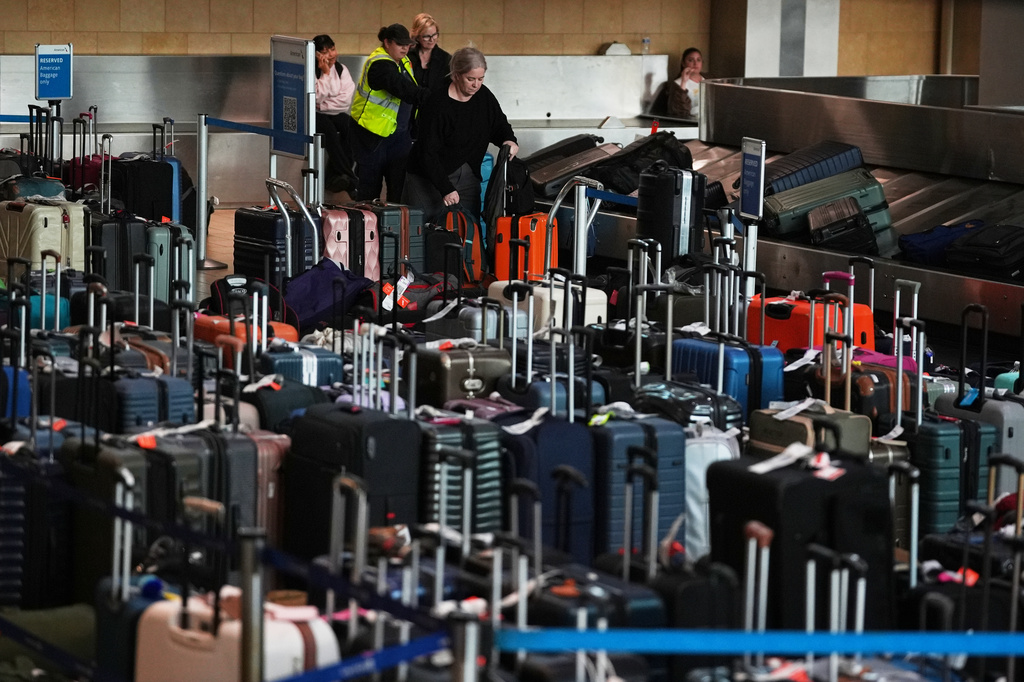
A woman moves past baggage at San Diego International Airport in San Diego, Monday, Nov. 16, 2026. (AP Photo/Gregory Bull) Photo: Associated Press